Total Pageviews

Monday, 8 June 2026

The New Byzantines: The Rise of Greece and the Return of the Near East

On 4 June 2026, the European Studies Centre hosted a book seminar with journalist and Middle East Eye correspondent Sean Matthews on his new book, The New Byzantines: The Rise of Greece and the Return of the Near East. Chaired by Othon Anastasakis, Director of South East European Studies at Oxford, the event explored Matthews's central argument that Greece is being reabsorbed into the Near East after a century of westward orientation.

Matthews opened with a reading from the book's epilogue, reflecting on his family's roots on the island of Oinousses. Through his great-grandfather's changing nationality on ship manifests—from Ottoman subject to Greek citizen—he illustrated how the collapse of empires reshaped identities. Greece, he argued, has long occupied a frontier between East and West, and that dividing line is becoming increasingly blurred. He noted that older travel writers readily situated Greece within the wider Near East and recalled that the United States treated Greece as part of its Near East portfolio until 1974.

He outlined three reasons why Greece matters beyond its borders: it was the first nation-state to emerge from the Ottoman Empire, the first site of sustained Western intervention in the region, and a key marker of the decline of the cosmopolitan order inherited from the Byzantine and Ottoman empires. The book's title, he explained, reflects the continuity between those empires and the hybrid cultural space they created.

Monday, 11 May 2026

Can cultural life thrive under authoritarianism? Evidence from Greece, 1970–1973

On 7 May 2026, SEESOX  hosted a seminar on the relationship between authoritarian rule and cultural creativity. Chaired by Othon Anastasakis, Director of SEESOX, who also served as discussant, the seminar featured Stathis Kalyvas, Gladstone Professor of Government and Fellow of All Souls College, Oxford, presenting his recent Greek-language book Big Bang 1970–1973. Best known for his work on civil war and political violence, Kalyvas turned to the cultural life of the Greek military dictatorship to ask a broader question: is the absence of freedom necessarily suppressive of culture?

Kalyvas began by observing that the answer is far from obvious. One intuition holds that repression stifles cultural life; another that hardship drives people to seek refuge in culture. The empirical record is mixed, with much richer cultural life in Brazil than in Pinochet's Chile, in Czechoslovakia than in East Germany, and in Iran than in North Korea. Greece under the Colonels (1967–1974)—the last successful military coup in Europe, launched by colonels against their own generals and ultimately undone by the Cyprus crisis and the Turkish invasion of 1974—is conventionally remembered as a "cultural desert". According to the standard narrative, the regime cut short the cultural renaissance of the early 1960s, forcing creativity underground into indirect resistance, symbolised by two émigré figures, the composer Mikis Theodorakis and the actress Melina Mercouri. Kalyvas structured his talk around four questions: whether there was high-quality cultural production under the dictatorship; if so, what explains it; why this has been forgotten; and why it matters.

His central claim was that the dictatorship was far from homogeneous. The first phase, from 1967 to 1969, broadly matched the conventional picture: a period of cultural "silence", with many established figures in self-imposed exile and writers refusing to publish. From 1969, however, a marked relaxation produced what he termed the "big bang". A key institutional change was the replacement of pre-emptive censorship, under which every work required approval before publication, with suppressive censorship, which allowed publication but exposed producers to penalties afterwards. Counter-intuitively, this emboldened artists. Kalyvas stressed that the existence of censorship should not be confused with its effectiveness. Censorship had a long pre-dictatorial history, functioned imperfectly like any bureaucracy, and often involved bargaining, with artists deliberately sacrificing some provocative material to preserve what mattered most.

Monday, 23 June 2025

Beyond Binaries: Contesting Pluralisms in Turkish Politics

On 17 June 2025, SEESOX closed its term with a seminar chaired by Othon Anastasakis. The event featured Associate Professor Nora Fisher-Onar, Chair of Global Studies at the University of San Francisco, who introduced her new book on Turkey’s “plural realities” and argued that conventional binary frames—East versus West, secular versus religious—obscure more than they explain.

Fisher-Onar began by explaining how conventional “either/or” frames—East versus West, secularist versus religious—distort our understanding of Turkey. She showed how cover images from The Economist, The Guardian and Der Spiegel rely on binary tropes (a bridge between continents, a covered versus an uncovered woman), whereas her book’s quilted-textile cover from Antalya’s open-air markets captures Turkey’s kaleidoscopic diversity. Those hard binaries, she argued, simplify causal complexity in political science, misguide policy towards Muslim-majority states (by backing whichever authoritarian model seems “our ally”) and fuel Islamophobia and right-wing populism at home.

Laying out her three-part structure—Theory, History and Twenty-First Century—Fisher-Onar described Chapter 1’s survey of three waves of Turkish pluralist thought: early Republican social engineering, mid-century democratisation that welcomed diverse societal energies, and a third wave of area-studies scholars crafting truly comparative approaches. In Chapter 2 she offered a new “complex-systems” key to politics, treating Turkey as a system defined by interacting parameters—ideas (normative repertoires), actors (strategic performers) and structures (from electoral laws to global power balances). Rather than isolating single causes, this lens traces how emergent coalitions—shifting alliances of pluralists and anti-pluralists—drive critical junctures.

Monday, 9 June 2025

From Anti-Americanism to Americanofilia: The United States in the kaleidoscope of Greek society

On 3 June 2025, SEESOX hosted an illuminating symposium entitled “From Anti-Americanism to Americanofilia: The United States in the Kaleidoscope of Greek Society.” Over the course of the afternoon, Lamprini Rori, Assistant Professor of Political Analysis at the National and Kapodistrian University of Athens, and Eirini Karamouzi, Associate Professor of Contemporary History and International Relations at the American College of Greece, presented preliminary findings from their joint research project. Their remarks were followed by commentary from Paul Betts (St Antony’s College, Oxford) and Dimitris Papadimitriou (University of Manchester). Together, they charted fifty years of Greek attitudes towards the United States, weaving together party politics, public opinion, media analysis and the performative rituals of state visits.

Dr Rori commenced with a mass-level perspective, demonstrating that Greek public opinion—drawn from Eurobarometer, MRP and national surveys—remained net negative towards the United States throughout the 1980s and 1990s, only tipping into mildly favourable territory in 2022. She highlighted a striking pattern of elite–mass convergence and divergence: in the 1980s both voters and party elites shared similarly anti-American sentiments; in the 1990s, elites became noticeably more pro-American than the electorate; in the 2000s, the public adopted scepticism aligned with the left-wing parties; and in the 2010s, citizens moderated their stance more rapidly than party leadership. Until the mid-1990s, ideological self-placement and party vote were strong predictors of attitudes to the US; after the financial crash, however, these factors lost explanatory power, leaving only pro-European orientation and attitudes towards Russia as significant correlates.

Monday, 19 May 2025

Europe and the Black Sea regional (in)security A story of Mutual Creation?

On 13 May 2025, SEESOX convened a seminar on Black Sea security and regional order. The event was chaired by Othon Anastasakis. The panel comprised Galip Dalay, Coordinator of the SEESOX Contemporary Programme, and Senior Consulting Fellow and Turkey expert at Chatham House; Natalie Sabanadze, Senior Research Fellow at Chatham House; Nigel Gould-Davies, Senior Fellow for Russia and Eurasia at the International Institute for Strategic Studies; Keir Giles, Senior Consulting Fellow at Chatham House; and Ian Lesser, Distinguished Fellow and Adviser to the President at the German Marshall Fund of the United States, who joined online. Together they assessed how Russia’s assertive policies, NATO’s evolving posture, and Turkey’s strategic balancing act are reshaping the security and normative landscape of the Black Sea basin.

Galip Dalay began by warning that Western focus on Ukraine has obscured the wider region’s agency. He argued that the Cold War–style emphasis on great-power projection—exemplified by Russia’s attempts to exclude other actors from the Black Sea—undermines the principle of regional ownership that underpins sustainable order. Moscow’s two decades of naval expansion and its denial of littoral states’ agency have in fact provoked complementary trends: a drive towards deeper European political and economic integration among coastal states, and renewed interest in small-scale cooperation projects, such as trilateral initiatives between Bulgaria, Romania and Turkey. For Dalay, Ukraine must remain a Black Sea power if it is to prevent a Russian monopoly; without Ukrainian naval capability, he cautioned, Russia will effectively transform the basin into its own “inland sea” and project influence into the global South via grain diplomacy and normative agendas.

Wednesday, 12 March 2025

The second Trump Administration: Implications for South East Europe

On 12 March, 2025, SEESOX hosted a seminar exploring the potential trajectory of U.S. foreign policy under a second Trump administration, with a particular focus on Europe, the Western Balkans, and Turkey. The panel featured Joan Hoey, Editor of the Economist Intelligence Unit’s flagship annual Democracy Index; Oana Lungescu, the longest-serving NATO Spokesperson and Romanian journalist; and Daniel Dombey, Executive News Editor at the Financial Times. The discussion was chaired by Othon Anastasakis.

Joan Hoey opened the seminar by characterising Donald Trump’s primary focus as domestic reconstruction rather than foreign affairs. According to Hoey, Trump’s overarching objective is to consolidate domestic governance and authority, rather than to seek international legitimacy through foreign policy exploits. Nonetheless, this inward focus will inevitably shape his approach abroad—particularly his determination to curtail overseas commitments that deplete U.S. resources.

Hoey emphasised that Trump is serious about negotiating an end to conflicts such as the Russo-Ukrainian War, aiming to prevent further crises that could entangle the United States. In regions like the Balkans, the administration would likely move away from the political engineering efforts seen under President Biden, instead prioritising stability and the containment of Russian and Chinese influence.

Although the Balkans may not initially be a high priority, Hoey suggested they could re-emerge on Washington’s agenda, especially given factors such as Trump Jr.’s business interests in Serbia and wider Eastern Europe, and Elon Musk’s engagement with Romania’s elections. Bilateral relations would likely be elevated, but through a transactional lens—Balkan leaders would be expected to align with U.S. preferences in areas such as energy and defence procurement.

Monday, 3 March 2025

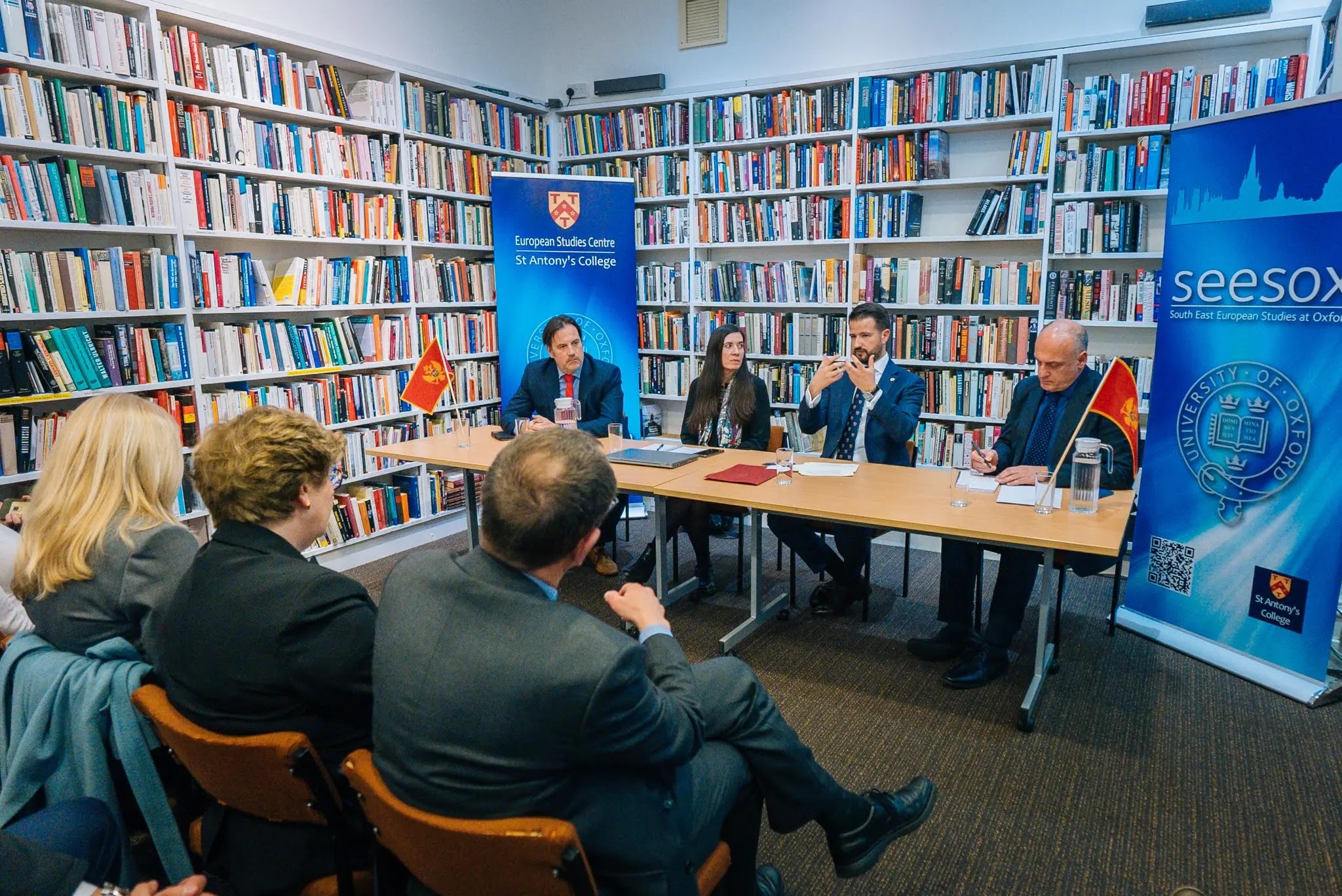
Montenegro: Next EU's member state?


“Partnership with the EU is more important today than ever, especially in light of geopolitical challenges”

President of Montenegro Jakov Milatović held a lecture at the European Studies Centre, St Antony's College at the prestigious University of Oxford, where he discussed with professors and students about Montenegro’s European future. The President emphasized that “the future of Montenegro and the Western Balkans is in an integrated Europe, based on common values ​​and interests, and emphasized that Montenegro’s membership in the EU is not just a technical process, but an opportunity to improve the quality of life of all our citizens by strengthening the rule of law, building an efficient public administration, achieving economic progress, ensuring equal opportunities for all and establishing zero tolerance for corruption.

“When I took office as President, I set an ambitious but achievable goal – for Montenegro to become the 28th member of the European Union by 2028. If you believe in what you are doing and work hard for that goal, it will be achieved,” said President Milatović. He recalled Montenegro’s strengths and its commitment to European values, the country is fully aligned with the EU’s foreign policy, uses the euro as its currency and is actively implementing reforms in the area of ​​the rule of law.

Tuesday, 18 February 2025

Europe and Middle Powers: EU's relations with India, Brazil and Turkey

The seminar, held on 18 February 2025, brought together experts to discuss how non-European actors and the “middle powers” – India, Brazil, and Turkey – fit into the evolving new global order. Chaired by Dimitar Bechev, Director of the Dahrendorf Programme at the European Studies Centre, the panel featured Kira Huju, Fellow in International Relations at the London School of Economics and Political Science, Rodrigo Fracalossi de Moraes, Researcher on Public Policies and International Relations at the Department of International Development at Oxford, and Galip Dalay, SEESOX.

The discussion began with a reflection on the importance of moving away from a Eurocentric viewpoint. The speakers examined how historical legacies, power dynamics, and past relationships continue to shape the role of non-European countries in global affairs. There was a strong emphasis on understanding how different regions engage with global institutions and major powers while also navigating their own internal political landscapes.

Huju, a former Oxford student and an expert on India, highlighted two key signals in the evolving relationship between the European Union and India. The first was the EU’s increasing eagerness to deepen ties with India, reflecting a shift in strategic priorities. The second was an implicit acknowledgment that the EU has significantly underperformed in its engagement with India, leaving much of the relationship’s potential unexplored. While the EU aspires to establish itself as a geopolitical player in the Indo-Pacific, this effort is largely confined to individual member states, such as France, which has prioritised defence cooperation with India. However, these national efforts do not necessarily translate into a coherent EU-wide approach.

Tuesday, 11 February 2025

The new European Parliament and European Commission: Who won the 2024 power-play in Brussels?

On February 11, 2025, SEESOX, together with the European Studies Centre, hosted an insightful seminar featuring Klaus Welle, former Secretary General of the European Parliament, and Anthony Teasdale, visiting professor in Practice at the European Institute of the London School of Economics. The event, chaired by Catherine Briddick, Andrew W Mellon Associate Professor of International Human Rights and Refugee Law at St Antony’s College, Oxford, focused on the shifting power dynamics in Brussels following the 2024 European elections, highlighting governance challenges, parliamentary realignments, and the future direction of European integration.

Klaus Welle opened the discussion by emphasising the unique structure of the European Parliament. Unlike national systems where power is fused within a parliamentary majority, the European Union (EU) operates through a diffusion of power. This federal-style system ensures that no single party dominates; instead, the EU is governed by a complex web of institutions—the Commission, the Parliament, and the Council—where alliances are essential to achieving legislative goals.

A key takeaway from Welle’s remarks was the changing composition of the European Parliament. The 2024 elections resulted in a divided assembly, with one-third of members aligned with left-wing parties, a strong centrist faction, and a growing presence of right-wing representatives. The steady rise of right-wing populist parties across member states, such as Le Pen’s National Rally in France and the Alternative for Germany (AfD), mirrors the broader European political landscape. Notably, the so-called “progressive majority” that had characterised the previous Parliament has now disappeared, with left-leaning parties falling below the 45% threshold necessary to form a stable coalition.

Monday, 3 February 2025

The Oxford Handbook of Religion in Turkey

On 28 January, the Oxford Middle East Centre joined SEESOX to host the launch of The Oxford Handbook of Religion in Turkey. The event marked the opening of the Michaelmas term’s Tuesday Seminar series and celebrated the publication of what promises to become a landmark volume in the study of religion and Turkish society.

The evening was introduced by Professor Eugene Rogan, who stood in for Professor Laurent Mignon—one of the book’s contributors and the original instigator of the launch event—who was unfortunately unwell. Professor Rogan warmly acknowledged Professor Mignon’s contribution to the volume and to the broader field of Turkish literary and religious studies, and he expressed what many in the audience likely felt: a desire to hear more from the editors and contributors about a book that brings together some of the finest contemporary scholarship on religion in Turkey.

Editors Professor Caroline Tee (University of Chester) and Dr Fabio Vicini (University of Edinburgh) opened the panel by sharing the origins and aims of the project. Conceived in the early days of the COVID-19 pandemic, the idea for the handbook grew from a desire for scholarly collaboration during a time of unprecedented isolation. Yet it was also driven by a clear sense that something was missing from the field. As Tee explained, there was a noticeable gap in accessible, interdisciplinary, and comprehensive studies on religion in Turkey—particularly ones that could serve both as teaching tools and as references for researchers.

Friday, 31 January 2025

The future of European security architecture

On 31 January 2025, the Eastern Mediterranean Programme at SEESOX supported a dialogue on the future of European security architecture, which was hosted by the Russian and East European Studies’ (REES) Discussion Group.

The panel of speakers consisted of three renowned individuals with a multifaceted expertise on the matter: Captain Kurt Engelen (Centre for the Study of Security and Defence of the Royal Higher Institute for Defence (RHID) of Belgium; General (ret.) Riho Terras (European Parliament and former Commander of the Estonian Armed Forces); and Kyriacos Kouros. (High Commissioner of Cyprus to the United Kingdom).

Finding solutions to energy insecurity will further stimulate growth, which the most important factor in regaining confidence amongst the developing world, which has recently been damaged.

Nonetheless, the importance of thwarting Russia’s advance in Ukraine was noted, with some speakers suggesting that ‘Ukraine is not losing’, due to the immense casualty-per-mile-gained ratio Russia faces. Concurrently, two of the speakers noted the importance of citizens actively engaging in supporting Ukraine, through personal initiatives and donations, with the war currently costing each EU citizen, on average, not more than €3 per month. That said, the necessity for EU member states to start spending more on defence was raised, with some speakers noting their regret that Ireland commits a mere 0.5% on defence, even though an Irish official was appointed to head the European Union Military Committee (EUMC), with Austria only committing 0.7% of its GDP.

Monday, 9 December 2024

Russia's war against Ukraine: Consequences for South East Europe

On December 3 2024, SEESOX hosted an insightful seminar on the repercussions of Russia's ongoing war against Ukraine on South East Europe. The discussion brought together a panel of experts, including Julie Newton, Research Fellow at St Antony’s College, Oxford, Maxim Samorukov, Fellow at the Carnegie Russia Eurasia Centre, Kyril Drezov, Lecturer in Politics at Keele University, and Vuk Vuksanovic, Senior Researcher at Belgrade Centre for Security Policy. The seminar was chaired by Othon Anastasakis. Their presentations explored how Russia's geopolitical strategies and the ongoing conflict ripple across the Balkans and Southeast Europe, affecting energy security, political alliances, and regional stability.

Newton opened the seminar by contextualising Southeast Europe’s role in Russia’s broader confrontation with the West. She emphasised that the region represents a "grey zone" in European security, where external interventions by both Russia and the West remain possible. This grey zone is of strategic importance to Russia, as it seeks to undermine Western cohesion while preserving its influence through populist and illiberal allies in countries like Serbia and Hungary. At the same time, the region presents challenges for the West, as vulnerabilities in governance and societal frustration make it fertile ground for populism and external manipulation.

Newton highlighted Russia’s mid-term goals, including neutralising threats emanating from Ukraine, reshaping European security to deter NATO, and shifting the global balance of power away from Western dominance toward a Russia-China-led alternative. She argued that the Southeast region will remain a dynamic battleground in this larger geopolitical conflict.

Monday, 18 November 2024

Turkey and the European Union – Moving beyond membership with external differentiated integration

On November 12, 2024, SEESOX hosted a seminar featuring Meltem Müftüler-Baç, Dean of the Faculty of Arts and Social Sciences at Sabancı University, and Galip Dalay, senior consulting fellow at Chatham House and a doctoral researcher at St Antony’s College, Oxford. Chaired by Dimitar Bechev, the seminar explored the historical evolution of Turkey-EU relations, efforts in political and economic integration, and the future prospects of external differentiated integration as an alternative to full EU membership.

Müftüler-Baç began by tracing Turkey’s engagement with the EU, which dates back to its 1959 application for associate membership in the European Economic Community and the 1963 Ankara Agreement. These milestones provided a legal basis for Turkey’s eligibility for membership, though not a guarantee. While Turkey officially opened accession negotiations in 2005, progress has stagnated due to political and economic concerns, including opposition from France and Germany. In 2019, the European Parliament formally called for suspending negotiations, citing democratic backsliding and concerns over the rule of law. Despite these challenges, Müftüler-Baç highlighted alternative pathways for Turkey to maintain strong ties with the EU, such as adopting frameworks akin to Norway, Iceland, or the United Kingdom, which allow for economic integration without full political membership. Turkey’s ties with the EU were described as a “strategic partnership” by its foreign ministry in 2016-2017, although this concept remains vaguely defined and lacks institutional clarity.

Monday, 11 November 2024

Rethinking Europe’s East-West divide: Who will lead the EU?

On 5 November 2025, SEESOX, and  the European Studies Centre, hosted a seminar discussing how Europe’s East-West divide has shaped the power dynamics within the EU, focusing on the representation and influence of Central and Eastern European (CEE) countries. The panel featured Zselyke Csaky (Centre for European Reform), Hussein Kassim (University of Warwick), Mihail Chiru (University of Oxford), and Krisi Raik (International Centre for Defence and Security). The session, chaired by Eli Gateva (Oxford DPIR), examined CEE representation within EU institutions, their influence in shaping EU policy, and the challenges they face in advancing their agendas.

Representation gaps in EU leadership
Zselyke Csaky began the seminar by highlighting the persistent underrepresentation of CEE countries in EU leadership. Despite accounting for 40% of EU member states and 23% of the population, CEE nationals held only 6% of top EU leadership roles in 2024, with no CEE citizens appointed to senior positions in 2023. Csaky pointed out that while Russia’s invasion of Ukraine has spotlighted the strategic importance of CEE countries, representation remains skewed in favor of older member states, particularly in influential positions.

Csaky noted that established networks within EU institutions often hinder CEE countries' integration. While the European Commission has a relatively balanced setup, influential positions still disproportionately go to nationals of older member states. Hungary remains an exception, wielding symbolic influence through Prime Minister Viktor Orbán, whose controversial policies have amplified Hungary’s visibility but may ultimately undermine broader CEE interests. Poland, despite its size and potential for regional leadership, faces limitations due to political instability and challenges in coalition-building.

Monday, 21 October 2024

Exploring the New Spirit of Islamism: Interactions between the AKP, Ennahda, and the Muslim Brotherhood

On 15 October, 2024, Ezgi Basaran (St Antony’s College, Oxford, presented her latest book, The New Spirit of Islamism: Interactions between the AKP, Ennahda, and the Muslim Brotherhood, at a joint event hosted by the Middle East Centre and SEESOX. As Michael Willis (St Antony’s College) noted in his introduction, the book evolved from her PhD research and offers a fresh perspective on Islamist movements. Ezgi’s background as a journalist uniquely equipped her to uncover the often hidden dynamics between these groups, which she examines through a blend of academic rigor and accessible storytelling.

Shifts in Turkey and its role on the global stage
Ezgi began her talk by reflecting on her time with the Contemporary Turkey Programme at South East European Studies at Oxford (SEESOX) nearly a decade ago, when there was still a glimmer of hope that Turkey might align itself more closely with Europe. However, the political landscape has shifted dramatically since then, both in Turkey and globally. As she pointed out, Turkey today finds itself at increasingly fraught crossroads between Europe and the Middle East, which mirrors the broader complexities of regional politics.

Unpacking Orientalism and Islamism
One of the central themes of Ezgi’s book is how Orientalism continues to shape Western attitudes toward the Middle East. She emphasized that the West’s selective outrage toward conflicts in the region reveals deeply ingrained biases. This ties directly into how Islamism is often framed—either as a failure or as an ideological threat. Her research challenges these simplistic narratives by showing that Islamist movements like Turkey's AKP (Justice and Development Party), Tunisia's Ennahda, and Egypt’s Muslim Brotherhood are much more than ideological actors. They are political players operating within a neoliberal global order, seeking success and legitimacy in practical, not purely ideological, terms.

Tuesday, 4 June 2024

Democracy of the last man: The politics of demographic imagination

The European Studies Centre (ESC) held its annual lecture on 4 June 2024. The lecture was titled “Democracy of the last man: The politics of demographic imagination.” It was delivered by Ivan Krastev, ESC Visiting Fellow, and chaired by Othon Anastasakis, ESC director.

Krastev’s lecture focused on the importance and influence of demography on contemporary politics. It sought to weave together demographic trends – low fertility rates and aging populations – with migratory flows, national identity, feelings of anxiety about the future the nation, and warfare. He outlined the traits of his ‘last man’. While Fukuyama’s ‘last man’ was satisfied but not ambitious, ‘married’ to democracy but not in love with it, Krastev’s ‘last man’ is full of anxieties and terrified that his nation is on the edge of extinction. He is the last European, the last white man – terrified of the extinction of the political power of his nation or race. Krastev characterised this as ‘demographic bulimia’ – an anxious feeling driven by the perception that they are simultaneously too many and too few people on a specific territory: too many of ‘them’ and too few of ‘us’.

The central argument of Krastev’s lecture was that demographic imagination is a new substitute for political ideology, and that demographic transition and democratic transition are closely interlinked. He substantiated his central argument by positing that: (1) demography and demographic imagination are key to understand the changes in both domestic and international politics; (2) while demographic change will affect both authoritarian and democratic regimes, at least initially it will have much more destabilising effect on democracies; (3) demographic changes and the need of migration that they bring put the focus on the rights of the majorities and as a result they expose the two conflicting notions of ‘the majority’ – the ethnic majority and the electoral majority; (4) while demographic anxiety fuels political support for the far right both in Eastern and the Western Europe, the fears in these geographical areas lead to two different types of illiberal regimes.

Tuesday, 28 May 2024

The fall of dictatorship in Portugal, Spain, and Greece: 50 years on

On 28 May, SEESOX, in cooperation with  the European Studies Centre (ESC) hosted a panel on the fall of dictatorship, and the transitions to democracy, including their legacies on current political developments in Spain, Portugal, and Greece.

The panel consisted of Joao Carlos Espada, Professor at the Institute for Political Studies at the Catholic University of Portugal, Ainhoa Campos Posada, historian at the Universidad Complutense Madrid, and Harris Mylonas, Associate Professor at George Washington University’ Elliott School of International Affairs, focusing on Portugal, Spain, and Greece, respectively. The seminar was chaired by ESC and SEESOX director, Othon Anastasakis.

According to Joao Carlos Espada Portugal, Spain, and Greece are the first cases of what Samuel Huntington called “the third wave of world democratisation” which led to the fall of the Berlin Wall and the fall of Communism in Central and Easter Europe.

He argued that the military coup that heralded the establishment of democracy in Portugal on 25 April 1974 was followed by a clash between two radically different conceptions of democracy: on the one hand, popular/populist democracy, which was supported by the Communists in Portugal, and on the other, parliamentary democracy. Although (or perhaps because) the Communists were electorally beaten in the first democratic Portuguese elections in April 1975, they attempted a coup in November 1975 and they were defeated by a coalition of left and center-right parties led by Mário Soares, the leader of the Socialist party and lifelong opponent of the far right dictatorship of Salazar.

Dreaming of Europe: Work refugees and the migration crisis

On 28 May 2024, SEESOX, and the European Studies Centre (ESC) hosted Randall Hansen, Canada Research Chair in the Department of Political Science and, Director of the Global Migration Lab at the University of Toronto’s Munk School, to discuss his upcoming book Dreaming of Europe: Refugees and the Old Continent. Joining the panel to discuss Professor Hansen’s recent work was Catherine Briddick, Andrew W Mellon Associate Professor of International Human Rights and Refugee Law, and a Fellow of St Antony's College. Othon Anastasakis, ESC Director, chaired the seminar.

Through this research project, Hansen sought to understand the migration crisis from the perspective of the refugees themselves. He had undertaken ethnographic research in multiple sites in Europe and Africa, and started his presentation by illustrating the issue at hand through three vignettes. Each of them told the painful story of the arduous and precarious journeys of refugees from Mali, Cameroon, and Nigeria respectively.

He then framed the narrative of the migration crisis and his latest research on the rise of far-right politics in Europe. He argued that because most people in Europe believe the European Union is bad for migration, it is important to ‘get it right’ – that is, it is important to dispel the migration myths and strive to clearly understand the migration problem and implement effective policies to address it.

Hansen first underscored that Europe and the rich countries of the Global North are not hosting the bulk of the world refugee population; 75 percent of the refugees are in the Global South. The EU, according to him, is doing a bit more than the other rich countries, but not much more. This lack of burden-sharing is particularly important since Hansen considered that the West – and Russia – bear the greatest responsibility for the wars that have forced people to become refugees.

Wednesday, 8 May 2024

Reconceptualising the EU-member states’ relationship in the age of permanent emergency

On Wednesday 8 May, the SEESOX hosted a presentation by Stella Ladi (Queen Mary University of London) on “Coordinative Europeanisation.” Since 2008, the European Union has been engulfed in several crises. While distinct, these crises are feeding into each other and are testing the capacity and resilience of EU and member states. With the Covid-19 crisis, there has been a trend towards a new mode of “coordinative Europeanisation” in EU decision-making, altering the relationships between EU-member states in pursuit of fast policy responses.

Ladi defined coordinative Europeanisation as “a process where increased and often informal coordination between EU member states and EU institutions takes place during a crisis’ early stages in view of quickly devising policy solutions that work for everyone, thereby enhancing decision-making speed, reform ownership and policy compliance.” Coordinative Europeanisation, Ladi argued, may coexist with other pre-existing modes of Europeanisation, such as soft Europeanisation and coercive Europeanisation. At the same time, de-Europeanisation trends have also emerged.

In her research, Ladi seeks to understand the public policy agenda of the EU, asking whether the EU is managing to adequate
ly respond to global crises using existing as well as novel means. She raised three questions in particular. Firstly, in which policy areas is coordinative Europeanisation taking place? Secondly, is coordinative Europeanisation always linked to a crisis and/or an emergency? And thirdly, what kind of policy and governance solutions emerge out of these crises and how successful and long-lasting are they?

Friday, 8 March 2024

The Story Smuggler, or how to narrate the happened and the un-happened

On 8 March 2024, the European Studies Centre, together with South East European Studies at Oxford (SEESOX), hosted Bulgarian novelist, playwright, and author, Georgi Gospodinov, to discuss three of his works: The Physics of Sorrow (2011), Time Shelter (2020) and The Story Smuggler (2016). The discussion was chaired by Catherine Briddick, Andrew W Mellon Associate Professor of International Human Rights and Refugee Law and fellow of St Antony's College. Paul Betts, Professor of Modern European History and fellow at St Antony’s College, and Marilena Anastasopoulou, ESRC Postdoctoral Fellow at the London School of Economics and Political Science, provided commentary on Gospodinov’s works.

Gospodinov started by reading from his two books, The Physics of Sorrow and Time Shelter, and briefly discussed the writing process. The two books deal with markedly different themes. The Physics of Sorrow attempts to capture the nature of the Bulgarian sorrow. Gospodinov describes the Bulgarian sorrow as an experience which combines the sorrow of things that did not happen, or places that Bulgarians could not visit despite the hope or longing for them, and the culture of silence, which he describes as a combination of the culture of fear during Communism and patriarchal culture. According to the author, sorrow is both personal and political, connected with the developments in one’s country.