Total Pageviews
Monday, 23 May 2022
The future of European security after the war in Ukraine
Lord Robertson began by describing Russia as an immensely complicated entity. It was important to distinguish fact from fiction. The 9 May Victory Day parade in Moscow was impressive, but had nothing to do with the facts on the ground in Ukraine. The Ukrainians - part of anti-Nazi fighters in the Second World War- were now fighting Russia. And the Russian Army was apparently no longer capable of fighting against people who didn’t want them.
The parade prompted three observations: victory in the war was not Russia’s alone, but equally we should recognise Soviet losses; there was a danger of conflating Russia and Putin – the Putin clique was not representative of his people; Russia was given insufficient credit for allowing a peaceful transfer of power in Poland and a peaceful conclusion of communism. The contrast with China and Tienanmen Square was stark.
Putin gave a totally dishonest characterisation of Ukraine: because of his emotionalism and messianic obsession with Russia. But the West should avoid provoking the thin-skinned Putin into even more reckless behaviour. He appeared convinced that NATO was a threat; but if so, why had he moved all troops away from the NATO frontier?
Monday, 14 March 2022
Turkey Under Erdogan: How a Country Turned from Democracy and the West
Bechev began by commenting on Turkey’s role as a critical player in the war in Ukraine. The Turkish government is currently stuck in the middle, given the tremendous economic challenges it is facing, the pressure from a united opposition, the discontent brewing among the Turkish society, and now a geopolitical crisis in its neighbourhood where it has robust connections to both parties.
He then zoomed back from the current situation to talk about the evolution of Turkish foreign policy since the end of the Cold War. Turkey had reinvented itself from being an EU-applicant to a central player with connections throughout the Middle East, the Balkans and the Black Sea. Turkey had been very confident that it could shape its neighbourhood and its image, bringing together Islam, democratic experience, economic growth and a populist leadership style, until it discovered its limitations and faced a pushback. Despite the lessons learnt, Turkey still wants to influence its environment and to play a central role in the balance between the West, Russia and China. Turkey’s process of becoming an ambitious regional player as a result of domestic politics, geopolitics, and ideology, is one of the major themes in the book.
Monday, 28 February 2022
Bosnia and Herzegovina: Has the international community lost the plot?
The panel addressed at least four key aspects of the topic. The first one relates to the actions of local actors and what their long-term goals and strategies might be. The panelists expressed a joint concern about the lack of care among local leaders about the negative effects of ethnocentric rhetoric on B&H’s already fragile political structure. Jelena Dzankic, a part-time professor at the European University Institute, reminded the audience that B&H’s power-sharing constitutional framework has been vulnerable to ethnic entrepreneurs from all three dominant ethnicities ever since its creation with the Dayton Agreement in 1995. Nebojsa Vladisavljevic, a professor at the University of Belgrade, pointed out that ethnocentric leaders have their own vested interests in preserving B&H in its current format, given the expected lack of international tolerance for any unilateral action on the ground, but also because their political fortunes have already thrived despite – and perhaps because of – B&H’s power-sharing structure. Yet, Jasmin Hanic, an assistant professor at the Sarajevo School of Science and Technology, expressed his concern about the recent lack of cooperativeness by ethnic Serb actors even in legislative areas where they have traditionally acted in a constructive fashion.
Monday, 21 February 2022
Venizelos: Crete to Athens, The Great War and schism, Peace Conference and after
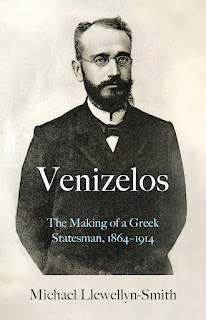
Michael Llewellyn Smith noted that 2022 was the 100th anniversary of the Asia Minor catastrophe and interest in Greece was already building up on Venizelos, the disaster, and in particular on who was to blame. He would concentrate on two themes: the early career of Venizelos, particularly in Crete; and the Asia Minor catastrophe. He would seek to answer three questions: what of Venizelos’s time in Crete bore on his later career? When did Venizelos first consider venturing into Asia Minor? And what caused the catastrophe?
Venizelos was Cretan in his bones: it was 45 years before his definitive move to Athens. And Crete was his apprenticeship in politics as a deputy in the Cretan assembly, in journalism, and in legal practice: the last in particular bringing him into contact with other groups (Muslims, Jews etc). He inherited Greek citizenship from his father, who was slow to allow him to attend Athens university, where he studied law, enlarged his friendships and gained the legal knowledge which allowed him to write two Cretan constitutions, and later a Greek Constitution. Venizelos was in too much of a hurry to master Cretan politics: but his clash with Prince George, the High Commissioner of the great powers, got him noticed in Athens, especially by the junior officers; and their take-over in 1909 took him to Athens and opened the way for the rapid development of his political career. A massive majority allowed his new constitution, an alliance with Serbia and Bulgaria in the Balkan Wars, and the beginnings of a focus on Greater Greece.
Monday, 14 February 2022
Crisis, reform and the way forward in Greece - A turbulent decade’
On 09 February, SEESOX hosted the second seminar of its 20th Anniversary Seminar Series. It addressed the issue of reform, focusing on Greece, a country that agonized over this notion during the recent years of its protracted economic crisis. The seminar built on the recently published book ‘Crisis, Reform and the Way Forward in Greece - A Turbulent Decade’ and the panel included Jens Bastian (Independent Economic Analyst, based in Athens), Michael Mitsopoulos (Hellenic Federation of Business) and Calliope Spanou (National and Kapodistrian University of Athens). It was chaired by Othon Anastasakis.
Calliope Spanou, the editor of the book, began by inviting us to move beyond the narrative of the economic crisis and the problems it exposed in Greece, and take a look at the wider challenges that lie ahead. She first explained the rationale behind the book and how it was conceived. The aim was to assess the extent to which the protracted crisis in Greece revealed (or not) resilience and led to deeper changes. In this context the book offers a reflection on the dialectics of stability and change and of external pressure and domestic agency. The perspective is forward looking: to examine the degree to which Greece is currently better equipped to deal with a global sociopolitical environment characterized by consecutive crises, the ‘new normal’ as the book’s authors call it.
In the remainder of her presentation, Spanou focused on public administration to illustrate (the limits of) Greece’s reform capacity, namely, its ability to endogenously set reform goals and to design and implement corresponding policies. Public administration in Greece, characterized by a series of structural problems, has been held responsible for many of Greece’s ills. Thus, horizontal reform became necessary. Making more specific reference to two critical domains, i.e. 1) budgeting, and 2) human resources management she concluded that the results were unbalanced. Regarding budgeting a coherent management system was introduced, and new instruments were developed under the auspices of the general accounting office of the Ministry of Finance, which assumed a central role. Overall, fiscal transparency was strengthened. Regarding human resources management, new digital tools were put in place and the whole technological infrastructure was upgraded with positive results. However, reform fell short in bringing the needed changes. Even less efficient was reform in terms of policy substance. In this domain, the status quo was largely reproduced. For instance, mobility remained individually centered and not in the interest of the service, while depoliticization was not implemented. The more recent appointment of ‘permanent secretaries’, who sit across the politically appointed general secretaries in Ministries, represents a potentially important step towards strengthening the civil service but will have to be tested against future government alternation.
Monday, 7 February 2022
What’s in a name? The classical Greek and Jewish diasporas and their implications for the present
Cohen began by pointing out the timeline of the classical Jewish diaspora, beginning with the destruction of Solomon’s temple in 568 BCE, through the founding, in 332 BCE, of Alexandria - a city whose Jews constituted more than a third of the population. The term “diaspora” had been attributed to the translators of the Bible into Greek in the Third Century BCE. He pointed out that, at the time, the Greek colonies in the Mediterranean and Black Sea broadly overlapped with the concentrations of the Jewish diaspora.
Noting that Thucydides had used the term “diaspora” with reference to dispersions of Greek populations, he wondered how distinct the two diasporas – Jewish and Greek – actually were. He felt that the Jewish diaspora often tended to be mischaracterised as linked solely to the dispersion after the destruction of Solomon’s Temple; in fact, while 25% of Jews went to Babylon, 75% remained in Judea and many later went elsewhere - to Alexandria and to the rest of the Mediterranean. Thus, the Jewish diaspora was in part involuntary and in part voluntary, thus resembling the Greek diaspora to some extent. The term “Greek civilisation” was an 18th Century invention; could diaspora likewise be used retrospectively?
Monday, 6 December 2021
'Open Balkan’ and/or European integration: An answer or a diversion?
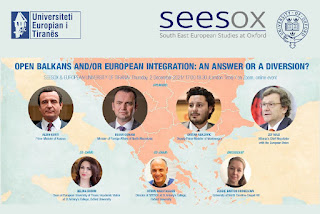
On 2 December 2021 SEESOX in cooperation with The European University of Tirana hosted an online panel discussion on the European and regional state of play of the Western Balkan countries entitled: “Open Balkans and/or European integration: An answer or a diversion?” Speakers included Albin Kurti, Prime Minister of Kosovo, Dritan Abazovic, Deputy Prime Minister of Montenegro, Zef Mazi, Albania’s Chief Negotiator to EU, and with Jessie Barton Hronesova, University of North Carolina-Chapel Hill, as a discussant. Othon Anastasakis, Director of SEESOX and Belina Budini, Dean of Faculty of Humanities, Education and Liberal Arts at European University of Tirana, co-chaired the event.
In his introduction Othon Anastasakis pointed out that the Open Balkans Initiative, like many other initiatives in the past, is based on ambitious principles of open borders, labor mobility and integrated regional market. But as many things in the region, it has also generated criticism and the mere fact that some countries are in and some countries not, is a testimony of the ambivalence of the project; some see it as an asset, while others as a liability and in competition with the European integration process.
Belina Budini, in her introduction of the topic pointed out that the Open Balkan Initiative, aiming at the creation of an open regional market, and signed by Albania, North Macedonia and Serbia, unavoidably raises the issue of compatibility with the European integration of the Western Balkan countries and their accession to the EU. Even though the project is represented as a call for action in response to the delay in obtaining EU membership, it has also attracted criticism on the grounds that it makes the region more vulnerable.